

|
Knees
Arthroscopy of the knee joint
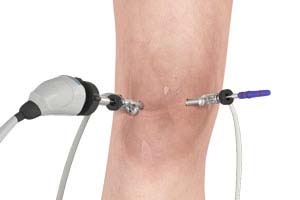
The arthroscope is a fibre-optic telescope that can be inserted into a joint (commonly the knee,
shoulder and ankle) to evaluate and treat a number of conditions .A camera is attached to the
arthroscope and the picture is visualized on a TV monitor. Most arthroscopic surgery is performed
as a Day-Only procedure and is usually done under general anaesthesia. Knee arthroscopy is a
common procedure and over 100 000 arthroscopies are performed in Australia each year.
Arthroscopy is useful in evaluating and treating the following conditions
1. Torn floating cartilage (meniscus):
The cartilage is trimmed to a stable rim or occasionally repaired
2. Torn surface (articular) cartilage
3. Removal of loose bodies (cartilage or bone that has broken off) and cysts.
4. Reconstruction of the Anterior Cruciate ligament
5. Patello-femoral (knee-cap) disorders
6. Washout of infected knees
7. General diagnostic purposes

Basic Knee Anatomy
The knee is the largest joint in the body. The knee joint is made up of the femur, tibia and patella
(knee cap). All these bones are lined with articular (surface cartilage). This articular cartilage acts
like a shock absorber and allows a smooth low friction surface for the knee to move on. Between
the tibia and femur lie two floating cartilages called menisci. The medial (inner) meniscus and the
lateral (outer) meniscus rest on the tibial surface cartilage and are mobile. The menisci also act as
shock absorbers and stabilizers. The knee is stabilized by ligaments that are both in and outside the
joint. The medial and lateral collateral ligaments support the knee from excessive side-to-side movement.
The (internal) anterior and posterior cruciate ligaments support the knee from buckling and giving way.
The knee joint is surrounded by a capsule (envelope) that produces a small amount of synovial (lubrication)
fluid to help with smooth motion. Thigh muscles are important secondary knee stabilizers.

Investigations:
A routine X-Ray of the knee which includes a standing weight-bearing view is usually required. An MRI
scan which looks at the cartilages and soft tissues may be needed if the diagnosis is unclear. There
is little value in the use of Ultrasound in investigating knee problems.
Meniscal Cartilage Tears:
Following a twisting type of injury the medial (or lateral) meniscus can tear. This results either from a
sporting injury or may occur from a simple twisting injury when getting out of a chair or standing from a
squatting position. Our cartilages become a little brittle as we get older and therefore can tear a little
easier. The symptoms of a torn cartilage include
- Pain over the torn area i.e. inner or outer side of the knee
- Knee swelling
- Reduced motion
- Locking if the cartilage gets caught between the femur a tibia

CARTILAGE TEARS
Once a meniscal cartilage has torn it will not heal unless it is a very small tear which is near the
capsule of the joint. Once the cartilage has torn it predisposes the knee to develop osteoarthritis
(wear and tear) in 15 to 20 years. It is better to remove torn pieces from the knee if the knee is symptomatic.
Torn cartilages in general continue to cause symptoms of discomfort, pain and swelling until the loose,
ragged pieces are removed. Only the torn section is removed and the knee should recover and become
symptom free. If the entire meniscus is removed, the knee will develop osteoarthritis in 15 to 20 years.
Now-days only the torn section is removed and it is hoped that this will delay the onset of long-term wear
and tear osteoarthritis.
Occasionally, provided the knee is stable and the tear is a certain type of tear in a young patient (peripheral
bucket handle tear), the meniscus may be suitable for repair. If repaired one has to avoid sports for a min
of three months.

Articular Cartilage (Surface) injury:
If the surface cartilage is torn, this is most significant as a major shock-absorbing function is compromised.
Large pieces of articular cartilage can float in the knee (sometimes with bone attached) and this causes
locking of the joint and can cause further deterioration due to the loose body floating around the knee
causing further wear and tear. Most surface cartilage wear will ultimately lead to osteoarthritis. Mechanical symptoms of pain and swelling due to cartilage peeling off can be helped with arthroscopic surgery.
The surgery smoothes the edges of the surface cartilage and removes loose bodies.
Anterior Cruciate Ligament Injuries:
Rupture of the Anterior (rarely the posterior) Cruciate Ligament (ACL) is a common sporting injury.
Once ruptured the ACL does not heal and usually causes knee instability and the inability to return to
normal sporting activities. An ACL reconstruction is required and a new ligament is fashioned to replace
the ruptured ligament. This procedure is performed using the arthroscope.

Patella (knee-cap) disorders:
The arthroscope can be used to treat problems relating to kneecap disorders, particularly mal-tracking
and significant surface cartilage tears. Patients may need to stay overnight if a lateral release has been
performed as knee swelling is quite common. The majority of common knee -cap problems can be treated
with physiotherapy and rehabilitation
Inflammatory Arthritis:
Occasionally arthroscopy is used in inflammatory conditions (e.g. Rheumatoid Arthritis) to help reduce
the amount of inflamed synovium (joint lining) that is producing excess joint fluid. This procedure is called a synovectomy. After the surgery a drain is inserted into the knee and patients generally require one or two
nights in hospital.

Bakers cysts:
Bakers cysts or popliteal cysts are often found on clinical examination and ultrasound / MRI scan. The cyst
is a fluid filled cavity behind the knee and in adults arises from a torn meniscus or worn articular cartilage in
the knee. These cysts usually do not require removal as treating the cause (torn knee cartilage) will in most
cases reduce the size of the cyst. Occasionally the cysts rupture and can cause calf pain. The cysts are not dangerous and do not require treatment if the knee is asymptomatic.
NEW TECHNOLOGY
Isolated areas of articular cartilage loss can be repaired using cartilage transplant technology. This is a new
and exciting field that is developing in the treatment of specific isolated cartilage defects in younger patients
The process is called Autologous Chondrocyte Grafting . It involves harvesting cartilage cells from the affected
knee, sending these cells to a laboratory and then culturing the cells to multiply into many cells. The large
amount of cells produced are then placed back into the affected knee into the defect requiring resurfacing.
Results are still short-term follow-up but are looking encouraging.
After a major cartilage or ligament injury has been treated the knee can return to normal function. There is
however a small increase in the risk of developing long-term wear and tear (Osteoarthritis) and depending on
the degree of injury activity modification may be required. Activities that help prevent knees deteriorating quickly include:
- Low impact sports like swimming, cycling and walking
- Reducing weight and maintaining a healthy diet

Arthroscopy of the knee: Patient Information
Please stop taking Aspirin and Anti-inflammatories 5 days prior to your surgery.
If pain medication is required use Panadol / Panadine or Panadine Forte. You can continue taking all your
other routine medication. If you smoke you are advised to stop a few days prior to your surgery.
You will be admitted on the day of surgery and need to remain fasted for 6 hours
prior to the procedure.
The limb undergoing the procedure will be marked and identified prior to the anaesthetic
Once you are under anaesthetic, the knee is prepared in a sterile fashion. A tourniquet is placed around the
thigh to allow a ‘blood – free' procedure.
The Arthroscope is introduced through a small (size of a pen) incision on the outer side of the knee. A second incision on the inner side of the knee is made to introduce the instruments that allow examination of the joint
and treatment of the problem.

Post-operative recovery
You will wake up in the recovery room and then be transferred back to the ward
A bandage will be around the operated knee.
Once you are recovered your drip will be removed and you will be shown a
number of exercises to do.
Your Surgeon will see you prior to discharge and explain the findings of the operation and what was
done during surgery.
Pain medication will be provided and should be taken as directed
You can remove the bandage in 24 hours and place waterproof dressings (provided) over the wounds.
It is NORMAL for the knee to swell after the surgery. Elevating the leg when you are seated and placing
Ice-Packs on the knee will help to reduce swelling. (Ice packs on for 20 min 3-4 times a day until swelling
has reduced)
You are able to drive and return to work when comfortable unless otherwise instructed
Please make an appointment 7-10 days after surgery to monitor your progress and remove the 2 stitches in
your knee.

Risks of Arthroscopy:
General Anaesthetic risks are extremely rare in Australia. Occasionally patients have some discomfort
in the throat as a result of the tube that supplies oxygen and other gasses. Please discuss with the
Specialist Anaesthetist if you have any specific concerns
Risks related to Arthroscopic knee surgery include:
- Postoperative bleeding
- Deep Vein Thrombosis
- Infection
- Stiffness
- Numbness to part of the skin near the incisions
- Injury to vessels, nerves and a chronic pain syndrome
- Progression of the disease process
The risks and complications of arthroscopic knee surgery are extremely small. One must however bear
in mind that occasionally there is more damage in the knee than was initially thought and that this may
affect the recovery time. In addition if the cartilage in the knee is partly worn out then arthroscopic surgery
has about a 65% chance of improving symptoms in the short to medium term but more definitive surgery
may be required in the future. In general arthroscopic surgery does not improve knees that have well
established Osteoarthritis.

Post –Operative Exercises and Physiotherapy
Following your surgery you will be given an instruction sheet showing exercises that are helpful in
speeding up your recovery. Strengthening your thigh muscles (Quadriceps and Hamstrings) is most
important. Swimming and cycling (stationary or road) are excellent ways to build these muscles up and
improve movement.
Frequently asked questions:
How long am I in Hospital?
A: Approx 4 hours
Do I need crutches
A: Usually not required (Unless having Anterior Cruciate Ligament Reconstruction)
When can I get the knee wet
A: After 24 hrs remove the bandage and apply waterproof dressing
When can I drive
A: After 24 hrs if the knee is comfortable
When can I return to work
A: When the knee feels reasonably comfortable
When can I swim
A: After removal of the stitches
How long will my knee take to recover
A: Depending on the findings and surgery usually 4 to 6 weeks following the surgery.
When Can I return to Sports
A: Depending on the findings, 4-6 weeks after surgery

|